How to Check Soil Moisture Before You Water
Four simple ways to find out whether a houseplant needs water: looking at the mix, the finger test, a wooden skewer and the weight of the pot, plus how to act on the result.
At a glance
What you need
- A clean finger
- Plain wooden skewer or chopstick
- Cloth to wipe the skewer between pots
- Moisture meter (optional)
The surface of a pot is a poor guide to what is happening around the roots. Knowing how to check soil moisture below that top layer is the difference between watering because the plant needs it and watering because the soil looks dry.
None of the four checks below needs special equipment. Each tells you something slightly different, and two of them together give a reliable answer in well under a minute per pot.
Why the surface misleads
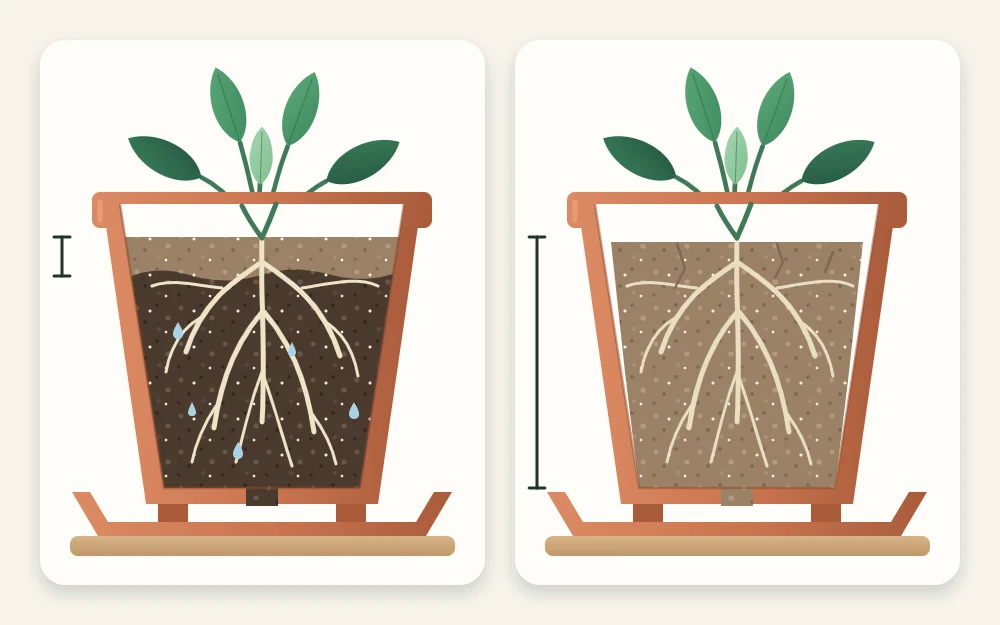
Potting mix dries from the top down. The surface is open to the air and to light, so it loses moisture first. Deeper in the pot, where most of the roots are, the mix stays moist for much longer, particularly in large pots, in plastic or glazed containers, and in dim or cool rooms.
The result is that a pot can look pale and dry on top and still be wet in the lower half. Watering by the look of the surface is one of the most common ways that mix ends up staying wet for too long.
Four simple checks, step by step
Work through these in order. In practice you will soon settle on the one or two that suit your pots.
- Look at the mix. Moist potting mix is usually darker, and dry mix is paler. Very dry mix often shrinks and pulls away from the edge of the pot, leaving a gap. Treat this as a first hint only, because it describes the surface.
- Use your finger. Push a finger straight down into the mix, away from the main stem. In a small pot, the first knuckle, about 1 in (2.5 cm), already reaches a good share of the depth. In a medium or large pot, go to the second knuckle, about 2 in (5 cm), or as deep as you can. Cool and damp means moisture is present. Dry and crumbly means that layer has dried.
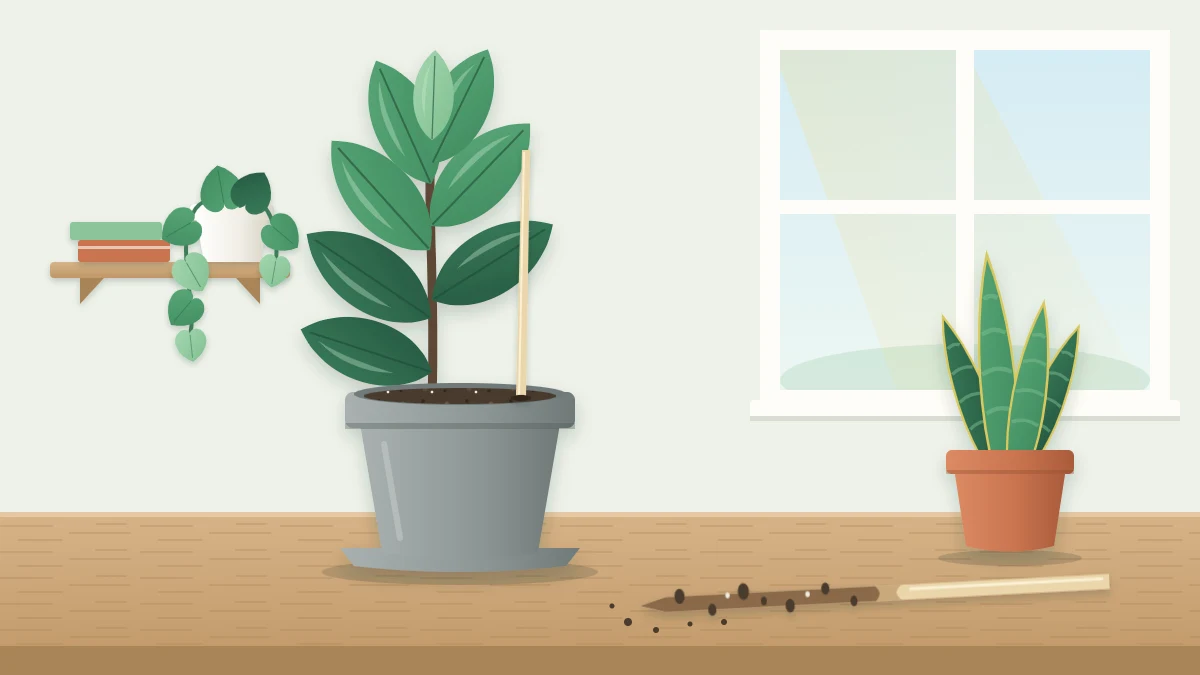
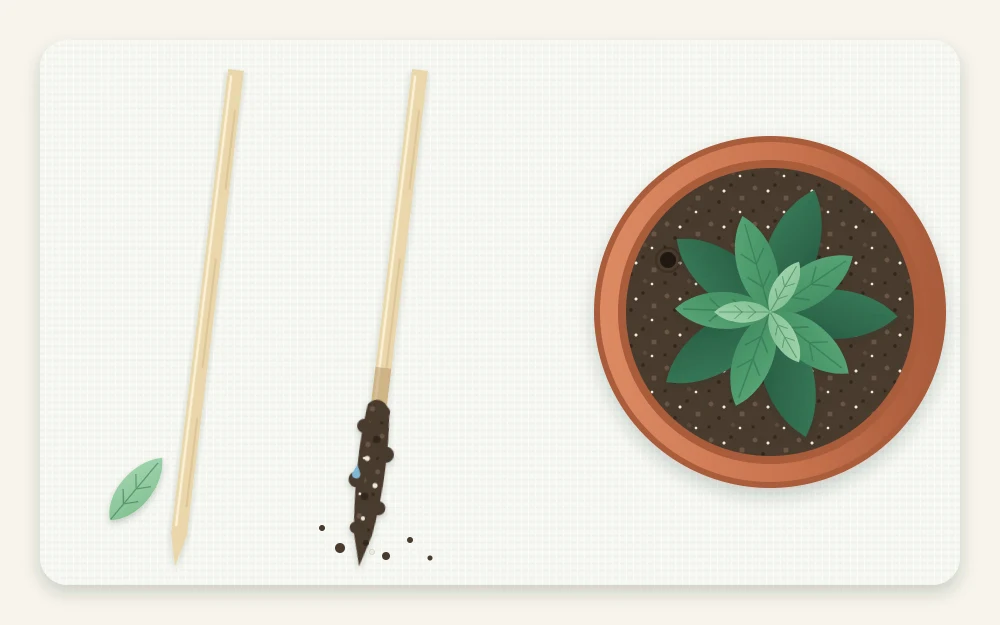
- Push in a wooden skewer. Slide a plain wooden skewer or chopstick down toward the bottom of the pot, near the edge to avoid the thickest roots. Leave it for a few seconds and pull it out. A clean, pale skewer means the mix is dry along its length. Dark, damp wood or clinging mix shows moisture, and how far up the mark reaches shows how deep the dry layer goes.
- Lift the pot. Water makes up much of the weight of a freshly watered pot. Lift the pot just after watering and draining to learn its heavy weight, then lift it again when the other checks say it is dry. After a few rounds, a quick lift tells you most of what you need.
What each check tells you
| Check | What it tells you | Its limit |
|---|---|---|
| Looking | Whether the surface is dry and whether the mix has shrunk | Says nothing about the mix lower down |
| Finger | Moisture in the upper part of the pot | Cannot reach the bottom of a deep pot |
| Skewer | Moisture through the full depth | Harder to read in chunky, bark-based mixes |
| Weight | The total water held in the pot | Needs a few comparisons to learn, and is impractical for heavy pots |
The type of mix changes what you feel. A dense, peaty mix feels obviously wet or dry, while an open mix with a lot of bark can feel dry to the touch and still hold moisture inside the pieces. The guide to potting mix for houseplants explains how the ingredients behave.
Moisture meters: a rough aid, not a verdict
A moisture meter is a probe that you push into the mix and read on a dial. It can be handy for deep pots where your finger cannot reach, but treat the reading as one more hint.
Readings vary with the potting mix, with how firmly the probe touches the mix, and with fertilizer salts that have built up in the pot. A meter can read “moist” in mix that is nearly dry, or the other way round. If you use one, compare it with the finger or skewer test on the same pot several times, so you learn what its readings mean for that plant.
Tip
Keep one plain wooden skewer near your plants and wipe it between pots. It is the simplest tool for reading the full depth of a pot.
Turning the result into a decision
A check gives you a fact: how far down the mix has dried. Whether that means “water now” depends on the kind of plant.
- Thin-leaved tropical foliage plants often want water once the upper part of the mix has dried and the lower part is still slightly moist.
- Succulents, cacti and plants with thick roots or rhizomes usually do better when the skewer comes out dry, or nearly so, along its whole length.
- Plants that prefer evenly moist mix may need water as soon as the surface starts to dry.
These groups are starting points, and the depths given above depend on pot size and plant type. Look up your plant by name to find where it sits, then adjust to what you see. Once the check says it is time, the guide on how to water houseplants thoroughly covers the watering itself.
If the mix is still moist at depth, wait and check again in a few days. Waiting a little longer is rarely a problem for most common houseplants. Adding water to mix that is already wet is the riskier choice.
When the checks and the plant disagree
Sometimes a plant droops while the mix is clearly wet, or the pot is light and dry a day or two after you watered it. Both are worth a closer look.
Wilting in wet mix may mean the roots are struggling and cannot take up the water that is there. A pot that dries very quickly may be full of roots, or the mix may have become so dry that water runs down the gap at the edge without soaking in. The article on overwatering vs underwatering explains how to tell these situations apart using what you find in the pot.
Good to know
Check on a regular day if that helps you remember, and more often for small pots in warm, bright spots. The check sets the timing. The day on the calendar does not.
Frequently asked questions
How deep should I check the soil before watering?
It depends on the pot. In a small pot, the first knuckle of your finger reaches a good share of the depth. In larger pots, go as deep as you can with a finger, or use a wooden skewer pushed toward the bottom, since the lower mix stays moist longest.
Are moisture meters accurate for houseplants?
They give a rough indication. Readings change with the type of potting mix, how well the probe touches it and any fertilizer salts in the pot. Compare the meter with a finger or skewer test on the same plant several times before you rely on what it shows.
The top of the soil is dry. Does my plant need water?
Not necessarily. The surface dries first, and the mix around the roots can still be moist. Check lower down with a finger or a skewer, or lift the pot to feel its weight. Then decide based on how dry your type of plant prefers its mix to get.